Key Takeaways:
- Effective healthcare disinfection depends on more than product selection; contact time, surface compatibility, staff training, and consistent auditing also matter.
- Involve infection prevention, environmental services, occupational health, and frontline staff in evaluating cleaning products and procedures.
- Use the hierarchy of controls and monitor both cleaning outcomes and worker health to build a safer, more sustainable program.
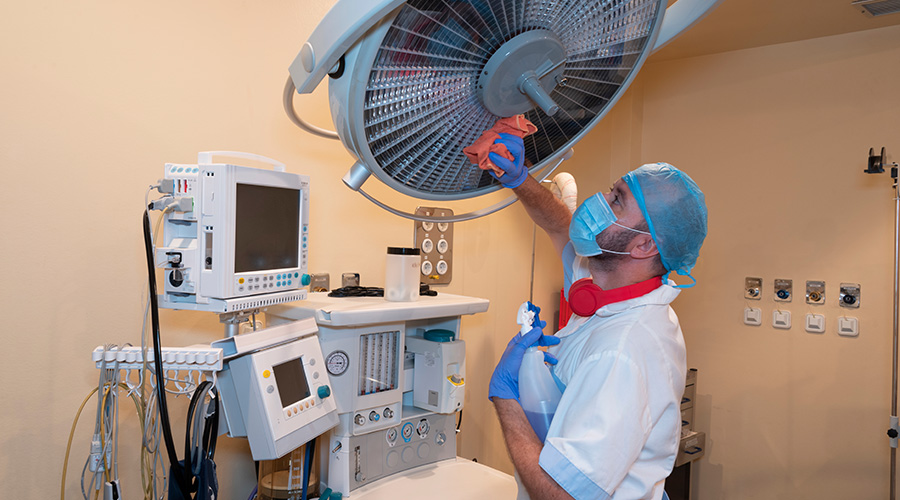
A 2015 article from the National Center for Biotechnical Information made a clear and convincing argument: Environmental cleaning in hospitals and other healthcare facilities must be managed as both an infection prevention intervention and an occupational health responsibility. Surfaces in these facilities can contribute to transmission of pathogens such as Clostridioides difficile, MRSA, vancomycin-resistant enterococci, norovirus and multidrug-resistant gram-negative organisms.
At the same time, the chemicals and work practices used to control these organisms can expose environmental services (EVS) workers, nurses and other staff to respiratory irritation, asthma, skin disease and other health risks. The authors of the article, Cleaning and disinfecting environmental surfaces in healthcare: Toward an integrated framework for infection and occupational illness prevention, called for a more coordinated framework that protects patients and workers simultaneously.
For infection preventionists, the article reinforced that surface cleaning and disinfection are not merely housekeeping tasks. They are core elements of healthcare-associated infection (HAI) prevention. High-touch surfaces, shared equipment and rooms occupied by patients on transmission-based precautions require reliable, evidence-based cleaning and disinfection. But effectiveness depends on more than selecting a disinfectant with the right kill claims. Contact time, surface compatibility, soil removal, staff training, workflow, auditing and feedback all influence outcomes.
For EVS managers, the article highlighted the need to recognize EVS workers as essential members of the infection prevention team. These workers often have the highest exposure to disinfectants, but they might have the least control over product selection, staffing, room turnover expectations and training resources.
Disinfectants such as bleach, quaternary ammonium compounds, hydrogen peroxide products and peracetic acid can be effective, but they can also cause eye, skin and respiratory symptoms if used improperly or without adequate controls. Safer use requires clear instructions, appropriate dilution systems, ventilation, personal protective equipment, realistic workload expectations and reporting systems for symptoms or incidents.
HFT Recommends: Respecting EVS Workers: 19 Minutes Is Not Enough
For EVS managers, the central message is that cleaning and disinfection should be governed through an integrated systems approach. Infection prevention, occupational health, EVS, safety, purchasing, facilities and frontline staff should jointly evaluate products and processes. Decisions should take into account antimicrobial efficacy, occupational exposure, surface damage, ease of use, cost, training needs and environmental impact.
The article encouraged applying the hierarchy of controls: Eliminate unnecessary chemical use where possible, substitute safer products when appropriate, use engineering controls such as closed dilution systems and ventilation, implement administrative controls such as standardized protocols and competency training, and provide personal protection equipment as the last line of defense.
The authors also emphasized measurement. Healthcare organizations should monitor cleaning thoroughness, disinfectant use, staff injuries and symptoms, compliance with protocols and infection outcomes. Feedback should be nonpunitive, and managers should use it for improvement. New technologies such as ultraviolet disinfection and hydrogen peroxide vapor might be useful adjuncts, but they do not replace manual cleaning and must be assessed for worker safety.
The practical takeaway is clear: Patient safety and worker safety are interconnected. A disinfection program that prevents infections but harms staff is not sustainable, and a program that is safer for workers but ineffective against pathogens is unacceptable. The goal is a balanced, evidence-based program that uses the right product in the right way for the right surface and risk level.
Infection preventionists, EVS professionals and managers should build shared accountability for clean, safe healthcare environments. By integrating infection prevention science with occupational health principles, managers and their organizations can reduce pathogen transmission, protect the workforce and strengthen the culture of safety.
J. Darrel Hicks, BA, MESRE, CHESP, Certificate of Mastery in Infection Prevention, is the past president of the Healthcare Surfaces Institute. Hicks is nationally recognized as a subject matter expert in infection prevention and control as it relates to cleaning. He is the owner and principal of Safe, Clean and Disinfected. His enterprise specializes in B2B consulting, webinar presentations, seminars and facility consulting services related to cleaning and disinfection. He can be reached at darrel@darrelhicks.com, or learn more at www.darrelhicks.com.
 Prefabricated Wall Panels Speed UCF Lake Nona Medical Center Construction
 New Dallas Pediatric Campus Reaches Topping-Out Milestone
 Hospitals Are Energy Super-Users. Why Is It So Hard to Modernize Them?
 Encompass Health Rehabilitation Hospital of Bangor Officially Opens